Tuesday, March 4, 2014

Caricatures in the Palm of Your Hand


The Palm is as famous for its caricatures festooning the walls of its restaurants throughout the country  as it is for its renowned gourmet meats and lobster. 

 
Welcome to the March edition of Not Your Usual Caricature Artist.

According to Wikipedia, here's the background on that curious marriage of cartoon and culinary arts:

"When Pio Bozzi and John Ganzi opened The Palm Restaurant in 1926, they had no money to decorate. Luckily, their location on Manhattan’s Second Avenue was in close proximity to the headquarters of King Features Syndicate and attracted a large clientele of cartoonists. In exchange for their meals, artists would often draw their own creations on the walls of The Palm.

"Over the years, the tradition of decorating our locations with caricatures has continued as we’ve expanded across the country and internationally. Before a new restaurant opens, 200 to 300 local notables' likenesses are placed on the walls, and new caricatures of regulars and celebrities are added regularly. Not surprisingly, the most in-demand wall space is at the original Second Avenue location, where only five caricatures are added each year due to space constraints."


Here in Charlotte, where we also have a Palm, sits Harry's Tavern & Grille, in the Ayrsley community, on S. Hwy 49, near I-485. The management enlisted me to draw some famous "Harrys" to carry through with their name, which now hang on the back wall of the restaurant. Among them are:


 You may not have a restaurant, but I'd be happy to help you adorn an office wall with fun pix of you, your staff, whomever...

See you again the first Tuesday of next month with an un-harried look at caricatures via Not Your Usual Caricature Artist.

Tuesday, February 4, 2014

Caricatures...and Cartoons, Too!


Humor comes in many forms -- in books, in essays, in movies, in the theater, on the radio, at comedy clubs.

And through cartoons.

Welcome to the February edition of Not Your Usual Caricature Artist. 

There's something about a printed cartoon, for me, that is especially gratifying. 

It's the marriage of art -- and perhaps a particular, quirky style of art -- with the written thought that will cause an organic or intellectual (it doesn't matter which) response from me that can be like eating that first spoonful of chocolate ice cream.  Delicious.

Humor, of course, is a subjective thing. For "illustration" purposes, though, this collection here is worth sharing:


In addition to drawing caricatures -- a related, though still different art form and discipline -- I've tried my hand at cartoons, as well. Here are a few I've done for different corporate clients.


Let me know if you see a cartoon or two fitting in with your business or social interests.

And see you again the first Tuesday of next month when we, ahem, draw more conclusions about caricatures and related art...

Joel Kweskin

Monday, January 6, 2014

The Thinking Behind The Drawing


So just how do you go about creating a caricature?

Welcome to the January edition of Not Your Usual Caricature Artist.

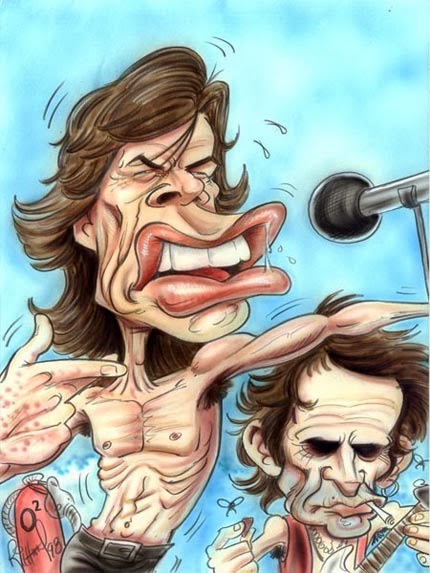
If you're Tom Richmond, Mad Magazine illustrator and one of the most sought-after commercial caricaturists in the country (check out Mick and Keith to the left, Letterman and Spielberg, below), your take on the subject goes something like this:

"How does one determine the 'correct' changes to make to a person’s feature relationships to make a good caricature of them? Well, that’s the trick, isn’t it? Every caricature begins with the observations the artist makes about the subject, and how their particular face is perceived by them. 


"MAD legend Mort Drucker has been quoted as saying that there is no 'one correct way' to caricature a subject. Any given subject can have several interpretations with respect to the exaggeration of the relationship of their features… and each may be as successful as the other. 

"That’s one of the unique things about caricature as an art form. Portraiture is basically absolute… Your drawing either looks like the person with the correct features, proportions and relationships, or it does not. 


"Caricature is subjective to a point. The artist's goal is to draw how they perceive the face, and exaggerate that perception. The result may be different than how others perceive that face, but...it can still be a successful caricature. 

"Iconic Broadway theater caricaturist Al Hirschfeld used to say he once drew Jimmy Durante without a nose at all, yet it was still recognizable as Durante."


Here are a recent few of my own -- all retiring executives...from Duke Energy, United Way and Belk:


See you again the first Tuesday of next month for another eye-opening opus of Not Your Usual Caricature Artist.


Joel Kweskin
www.caricaturesbyjoel.com
jk@caricaturesbyjoel.com
704.575.8850 


Tuesday, December 3, 2013

If It's Good Enough for The Met...


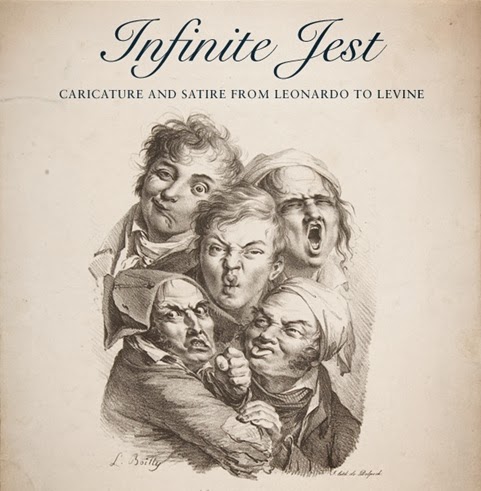
No less an august institution than the Metropolitan Museum of Art recently featured an hommage to the mischievous art form that is the subject of this monthly commentary and pictorial display.
Infinite Jest -- Caricature and Satire from Leonardo to Levine, according to the program notes, explored "caricature and satire in its many forms from the Italian Renaissance to the present, drawn primarily from the rich collection of this material in the Museum's Department of Drawings and Prints.

Welcome to the Winter Solstice edition of Not Your Usual Caricature Artist.
The show included drawings and prints by Leonardo da Vinci, Eugène Delacroix, Francisco de Goya, Henri de Toulouse-Lautrec, and Enrique Chagoya "alongside works by artists more often associated with humor, such as James Gillray, Thomas Rowlandson, Honoré Daumier, Al Hirschfeld, and David Levine. Many of these engaging caricatures and satires have never been exhibited and are little known except to specialists.

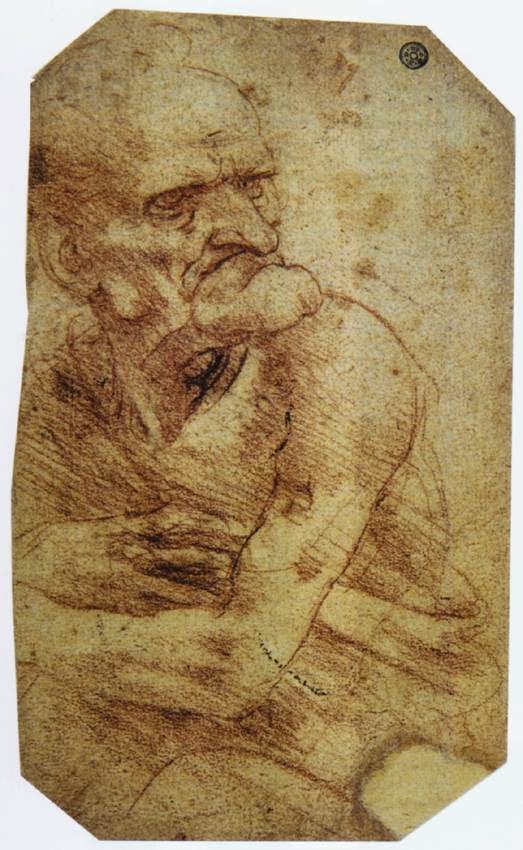
"In its purest form, caricature—from the Italian carico and caricare, 'to load' and 'to exaggerate'—distorts human physical characteristics and can be combined with various kinds of satire to convey personal, social, or political meaning. Although caricature has probably existed since artists began to draw (ancient examples are known), the form took shape in Europe when Leonardo da Vinci's drawings of grotesque heads were copied by followers and distributed as prints.
"The exhibition's title derives from Hamlet, which is quoted in a Civil War print that uses the famous line: 'I knew him, Horatio; a fellow of infinite jest' to mock Lincoln."

Some samples from the exhibit:


In more recent times -- though not likely museum-worthy -- these commissioned pieces were produced by yours truly: the retiring tax accountant executive at Belk, and three of the cook staff at Hawthorne's Pizza:


Wishing you a happy and healthy holiday season.
See you the first Tuesday on the other side of the New Year.
Joel Kweskin


Monday, November 4, 2013

Renaissance Man


I've always maintained that caricature artists are, naturally, geniuses.
Well, at least one was.
Through various online sources, Leonardo Da Vinci (1452-1519) is described as a "polymath -- displaying skills in numerous diverse areas of study.

While most famous for his paintings such as The Last Supper and the Mona Lisa, Leonardo conceived ideas vastly ahead of his own time, conceptually inventing the helicopter, the tank, the use of concentrated solar power,  and a rudimentary theory of plate tectonics. In practice, he greatly advanced the state of knowledge in the fields of anatomy, astronomy, civil engineering, optics, and the study of water (hydrodynamics)."
But this acknowledged genius was also, in his capacity as arguably the leading progenitor of Renaissance art...a caricature artist.
Welcome to the November edition of Not Your Usual Caricature Artist.
According to artist and biographer Giorgio Vasari, Leonardo was "so delighted when he saw curious heads, whether bearded or hairy, that he would follow anyone who had thus attracted his attention for a whole day, acquiring such a clear idea of him that when he went home he would draw the head as well as if the man had been present."
Further, "Leonardo actively sought people with deformities to use as models. The point was to offer an impression of the original which was more striking than a portrait."

He "was fascinated by people with 'bizarre heads' and often followed them around to memorize their features, later copying or exaggerating them in his drawings. Throughout his career Leonardo produced many studies on different types of faces because in a desire to explore human physiognomy. He created numerous such small drawings of heads, which he called visi monstruosi (monstrous faces).
To wit:


Now I don't claim to be another Leonardo -- though I did read "The Da Vinci Code" and enjoyed it more than the movie.  But I digress...
Here are my explorations of visi monstruosi.  (Just don't tell these people that's how I referred to them...)


See you again the first Tuesday of next month for another exaggerated edition of Not Your Usual Caricature Artist.
Tuesday, October 8, 2013

Got You Covered

Time Magazine has been around since 1923, America's first -- and still foremost -- news magazine. Pictures of the famous, not-so-famous and infamous have graced -- and disgraced -- its covers. But not all the pictures, through 90 years of chronicling influential people and events of the world, have been photographs. Some have been -- egads! -- caricatures.

Welcome to the October issue of Not Your Usual Caricature Artist.

Here are some samples through the years. Nice to see one of my favorite caricaturists -- Jack Davis of Mad Magazine fame (the first three pictured) --  among the distinguished represented.


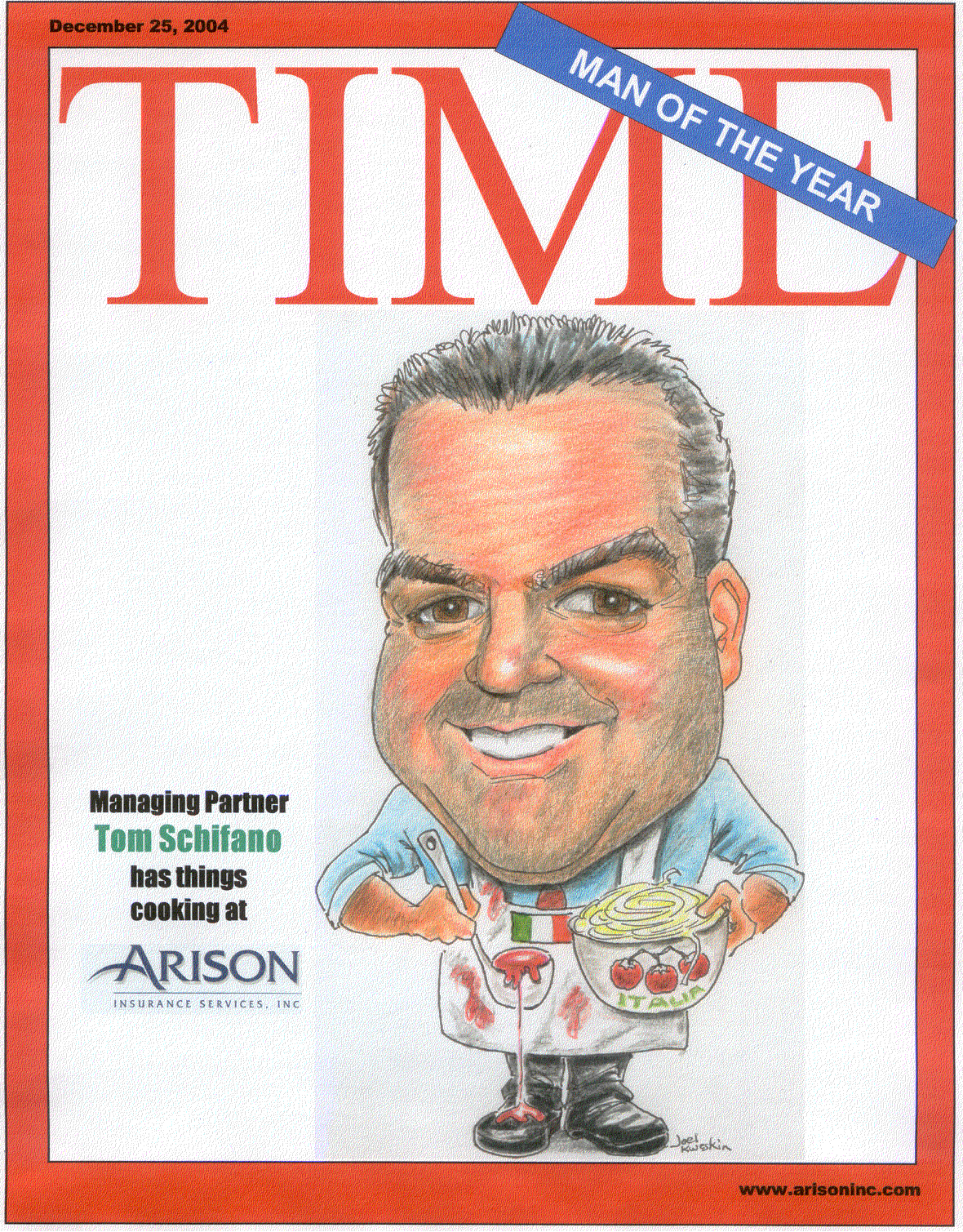
I've done a few Time covers myself.

Well, not really. But these are commissioned works that have made clients...or clients of clients...feel special, having been made "Time's (blank) of the Year."


Anyone you know who might enjoy this uniquely fun recognition?

See you again the first Tuesday of next month for another periodical edition of Not Your Usual Caricature Artist.

Tuesday, September 3, 2013

Social Satire Rendered by Brush Stroke

September means Summer is officially over, school has begun and our thoughts turn to Football, the vacation-less grind of work and the mundane drone of day-to-day life.

I'm reminded of a 20th Century artist whose subjects often touched on the everyday tableaux of the American scene. But whose whimsical touch always enlivened the proceedings.
 
 
Welcome to the Autumnal Equinox edition of Not Your Usual Caricature Artist.
Jack Levine (1915 – 2010) was a New York-based "Social Realist" painter known for his satirical interpretations of modern life and political machination. His work can be viewed in some of the Nation's premier museums and galleries.
According to Wikipedia, Levine "focused his sardonic eye and acerbic wit on everyone from gangsters, politicians and cops to the dealers, critics, collectors and auction houses of the contemporary art world. His lifelong love of the Old Masters and dedication to exacting technique led to the development of a multifaceted painting style in which distortions are used for emphasis and highlights are refined to a jewel-like brilliance."
It's the "distortions" that have drawn me to his works.  Because, although he is very painterly and "fine art" in his application, Levine's unique style informed his work much like that of a caricature artist. 

To wit:


Here's some "corporate" work of my own, commissioned as gifts to honor these business people.


Hope to see you again the first Tuesday of next month for another whimsical whack at the work of Not Your Usual Caricature Artist.
 
Joel Kweskin