Tuesday, April 5, 2016

Diamonds are This Artist's Best Friend

By popular demand, I am reprising Vol. I, No. 4's (2013) edition of this post (with some minor updating).

By who's demand?  Mine, of course.

It's our annual salute to Baseball, and it simply accommodates my schedule this time around to run this post once more.

------------------------------------------------------------------


Ah, April.

That may mean one thing to tax accountants. But to yours truly, it means the start of -- depending on where you begin its history -- the 110th combined (National and American Leagues) season for our National Pastime.

Welcome to the horsehide-and-stitches edition of Not Your Usual Caricature Artist from Caricatures by Joel.

When I was a kid growing up in New York City, many considered that time to be a Golden Era of Baseball. After all, the Yankees had names like Mantle and Maris, Ford and Berra. The Dodgers and Giants eventually moved to the West Coast and the Mets came along to fill the National League gap with their own names (often of both repute...and ill repute): Throneberry and Hunt, later Seaver and Swoboda.

During that time, there were two newspaper cartoonists chronicling the exploits of these teams: New York World Telegram artist Willard Mullin and Daily News cartoonist Bill Gallo. For a kid like me -- the son of two artists and spellbound by Baseball -- it was a delight to check the paper each day and see what subject each of them might tackle.


Interestingly, each one came up with his own original character that has gone down in Baseball illustrated lore: Gallo's "Basement Bertha," generally representing the lowly Mets...and, more famously, Mullin's "Brooklyn Bum," depicting the Dodgers.


Now, ironically, I have no "pure" Baseball caricatures of my own to show; what I've done in the past have been given away as gifts.

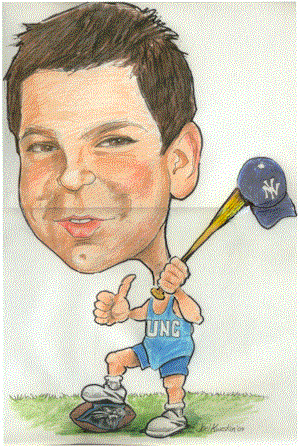
But here are caricatures I did of two young men for their Bar Mitzvah Sign-In Board...and because for these sports multi-taskers there's a bat and a New York Yankees logo in them, they will have to suffice.


Here, too, are a drawing I did of one of the amateur sports coaches for the Powerade State Games tournament...and of Jordan Danks, a former Charlotte Knight, as commissioned by the team and presented to him -- at home plate -- as the all-time team hits leader.


What sport do you or a client, colleague, friend or family member enjoy...either reminiscing about or actually playing?

I'd love to help you put him or her in their own, personal Hall of Fame.

In the meantime, "Play Ball!" And see you again the first Tuesday of next month for another pitch right down the middle, from Not Your Usual Caricature Artist.

Joel Kweskin

Tuesday, March 1, 2016

Lights, Camera, Action!

In the wake of the recently televised Academy Awards, I got to thinking about movies made about…artists. And you know what – there’s a surprisingly ample number of them. 

There are biopics about the famous, the infamous and the obscure. About realistic artists, abstract artists, historical artists, contemporary artists, even a cartoonist or two…

Welcome to the March edition of Not Your Usual Caricature Artist from Caricatures by Joel.


If you want to be impressed by the sheer number of films devoted to this subject, and perhaps note those you’ve either seen or want to see, check out:


In no particular order, then, here are some fine representatives of the genre:

·       “The Agony and the Ecstasy” – 1965 – Charlton Heston as a burly Michaelangelo.

·       “Lust for Life” – 1956 – Kirk Douglas as the tortured Vincent Van Gogh and Oscar winner Anthony Quinn as Paul Gauguin.

·       “Frida” – 2002 – Salma Hayek as Mexican artist and eyebrow-challenged Frida Kahlo.


·       “Crumb” – 1994 – documentary about R. Crumb, avant-garde/bohemian cartoonist.

·       “My Left Foot” – 1989 – Daniel Day-Lewis as Irish artist/writer, and Cerebral Palsy victim, Christy Brown.

·       “Moulin Rouge” – 1952 – Jose Ferrer as Toulouse Lautrec.

·       “Pollock” – 2000 – Ed Harris as American abstract artist Jackson Pollock.

·       “Rembrandt” – 1936 – Charles Laughton as the famed Dutch painter.

·       “Girl with a Pearl Earring” – 2003 – Scarlett Johannsen as the eponymous “girl” in a famous painting by master of lighting Johannes Vermeer.

And last…and probably least (for this arbitrary, short list)…

·        “How to Murder Your Wife” – 1965 -- Jack Lemmon as fictional comic strip artist Stanley Ford who wakes up the next morning after a drunken bacchanal to realize he’s suddenly married to Virna Lisi.

(Well, you know it’s a comedy if any guy in his right mind wants to do away with Virna Lisi.)

------------------------------------------------------------------------
As for yours truly, no Oscar winners here, but some recent work at a wedding where I at least "immortalized” the guests as if they were stars:


Look for us again the first Tuesday of next month for another Todd-A-O, Technicolor and VistaVision adaptation of Not Your Usual Caricature Artist.


Monday, February 1, 2016

Can Caricature Drawing be Taught?


Can caricature drawing be taught?

Well, there are books on the subject, YouTube videos abound and there are some schools throughout the country whose curriculum embraces it in all seriousness, as they say.

One of the more renowned is the Kubert School, formerly the Joe Kubert School of Cartoon and Graphic Art or Joe Kubert School, located in DoverNew Jersey, a three-year technical school that teaches the principles of sequential art and the particular craft of the comics industry as well as commercial illustration. The Kubert School was and still is the only accredited school devoted entirely to cartooning, caricaturing being among the subjects covered.


Welcome to the February edition of Not Your Usual Caricature Artist.


Despite the institutions and programs previously noted, I'm not entirely convinced that one can be taught to draw the human face and distort it in such a way as to get at both the individual's resemblance and their personality. And to do it all in a way that ultimately engenders a smile or chuckle -- or even a hearty guffaw -- from the subject him/herself.  It's kind of like learning to be a comedian; it's been said by professional comics that one has to be almost born with the skills -- to craft a phrase in just the right way, with pacing and timing that must be critically paired with it.

Does that make me and my fellow caricature artists geniuses of some sort?

No, it just means that we can draw to begin with...have a faculty for portraiture in replicating the human face...and are somehow hard-wired to evince, from our own humor-skewed sensibilities, a comical view of that individual through exaggeration and "enhancement" of their features.

Enough philosophical and anecdotal mumbo-jumbo.

Here are some recent caricatures done at a corporate event in Greensboro, NC.


Catch up with us again on the first Tuesday of next month with another scholarly treatise from Not Your Usual Caricature Artist.

Tuesday, January 5, 2016

The China Marker Syndrome


What distinguishes one caricature artist from another?

Well, it could be the style of art. Is someone more "cartoon-y" than another?  More illustrative in approach? Looser with his line?  More detailed? Certainly personality plays a large part, too.

When it comes to drawing "live" at an event, however, what distinguishes me right off the bat is the instrument I use. 

While virtually every artist I know -- here in Charlotte, anyway -- uses a Sharpie ink pen, kind of like a Magic Marker, I use a utensil that, more likely, your Mom used in the kitchen, or your Dad used in his workshop.

I'm talking about a China marker.


Happy New Year and welcome to the January edition of Not Your Usual Caricature Artist from Caricatures by Joel. 
 

Whether manufactured by Dixon, Berol and even Sharpie, China markers have many names; the most common include grease pencils and wax pencils, referencing the materials making up the markers. 

China markers contain no ink; they look more like pencils with very thick, shiny tips. Thick paper wraps around the tip and body of each pencil with a string bound right next to the wax or grease core. Pulling down the string and peeling away the paper allows access to more writing medium.  

China markers write on almost anything, including slick surfaces like glass, acetate, smooth plastic and photos. And, of course, China. It also wipes away easily without leaving a stain. There are several color choices in addition to black to temporarily decorate windows or to write names on glasses during a party.
 
Interesting FYI from Wikipedia: "Grease pencils were...widely used during the mid-20th century in aircraft control centers, military radar defense system stations on land and on aircraft carriers in particular. As information came in from radar operators and radio, men would take details of aircraft locations, vectors, weapons and fuel status and other information and write it in reverse on a large, clear panel of glass, which was readable to the officers on the other side of the panel. The information would be continuously updated as the situation changed. They have largely been replaced by digital displays in the modern era.


"The pencil is usually made from non-toxic opaque wax similar to a crayon but stronger.. Marks made by grease pencils are resistant to moisture and can usually be removed by rubbing the marked surface with a paper towel.

"Grease pencils were used on the Sykes-Picot Agreement map in 1916, used by Great Britain, France and Russia to carve up the Middle during World War I, and by Russell Crowe in his portrayal of economist John Nash in the 2001 movie "A Beautiful Mind," when he writes some equations on a window.
 "Walt Disney was known to use a red grease pencil."


...So why do I use a China Marker and not a Sharpie pen?

I like the depth and texture it produces when it meets with the "teeth" of the paper I use. I also like the ability to shade for a more dramatic look. I like the nuanced effect it can give by going from very dark to light grey with just a lighter stroke of my hand.
And, frankly, I like it as a "hook" in my arsenal that further distinguishes me from other artists.

 
Join me again the first Tuesday of next month when we peel away more of the fascinating subject of caricature art with Not Your Usual Caricature Artist.


"Grease pencils were used on the Sykes-Picot Agreement map in 1916, used by Great Britain, France and Russia to carve up the Middle during World War I, and by Russell Crowe in his portrayal of economist John Nash in the 2001 movie "A Beautiful Mind," when he writes some equations on a window.
 "Walt Disney was known to use a red grease pencil."

...So why do I use a China Marker and not a Sharpie pen?

I like the depth and texture it produces when it meets with the "teeth" of the paper I use. I also like the ability to shade for a more dramatic look. I like the nuanced effect it can give by going from very dark to light grey with just a lighter stroke of my hand.
And, frankly, I like it as a "hook" in my arsenal that further distinguishes me from other artists.

Join me again the first Tuesday of next month when we peel away more of the fascinating subject of caricature art with Not Your Usual Caricature Artist.

Tuesday, December 1, 2015

West by Southeast


Over Thanksgiving weekend, I was in the Atlanta area visiting my son and his wife and decided to haul the family about an hour Northwest of the city to Cartersville, GA.

A small, unassuming exurban satellite to Atlanta, hardly associated with one of the more impressive -- and fun -- art museums I've ever been to. Anywhere.

Welcome to the December edition of Not Your Usual Caricature Artist from Caricatures by Joel.

I'm referring to the Booth Western Art Museum. http://boothmuseum.org/
What a treat for this guy who, as a child of the '50s, looked forward to "Wyatt Earp" and "Maverick" and "Bat Masterson" and "Roy Rogers" and "The Lone Ranger" on the old black and white boob tube. And, in the "air cooled" movie theaters, "Gunfight at the O.K. Corral" and "Last Train from Gun Hill" (both featuring Kirk Douglas) and "Rio Bravo" and "Shane" and "The Lone Ranger." (Yes, they made a couple of feature length films of the latter, based on the tremendous popularity of the TV series.)

The Booth features movie posters and pulp Western book jacket illustrations and, of course, majestic paintings and photography and crafts and sculpture depicting the flora and fauna of magnificent settings like the Grand Canyon and the Rockies, along with those that explored and settled the territories -- the cowboy and the Native American.

For those of you who share my enthusiasm for this uniquely American substrata of art appreciation, there's a brand new art gallery in Charlotte, inspired in part, by the Booth.  And since they are a client of mine, I'm pleased to endorse them here. (But even if they weren't, you really owe it to yourself to check them out) http://www.cimarronskygallery.com/


Ironically, I have never indulged in tackling this subject myself, so I have little to show for my trumpeting.

Perhaps you'll indulge me, though, with these corporate assignments that, with the exception of one caricature -- of Tim Rowley, owner of Cimarron Sky Gallery (just below) -- at least have some element within them to tie into the Western theme. :-)


Incidentally, the art at the very top of this post is a book jacket cover illustrated some five decades ago by Sam Kweskin...I'm very proud to display

Adios until the first Tuesday of next month for another Yipee Ki-yo Ki-yay rendition of Not Your Usual Caricature Artist.

Tuesday, November 3, 2015

Giving Thanks this Month


Thanksgiving may be my favorite holiday. (Then again, any celebration involving the eating of mass quantities of food probably qualifies.)
Thanksgiving, though, certainly holds a special place in the collective consciousness of our country.
On the serious, historical side, it denotes the pilgrims' flight from Europe for a land where they could exercise freedom of religious expression.
On the lighter but no less significant side, it connotes the warmth and love associated with gatherings of family and friends.
Welcome to the November edition of Not Your Usual Caricature Artist from Caricatures by Joel.
(Used to be, for some reason it was also the one Thursday out of the season when the NFL Detroit Lions -- alone -- would be pitted against another team. Now it's also the Cowboys that play and maybe others. And Thursday, of course, is now part of the schedule throughout the entire season. So much for "tradition." But I digress...) 
Through the years, Thanksgiving and all its fun and foibles has been comedic grist for chroniclers from publishers The New Yorker to Mad Magazine, from animators Walt Disney to Warner Brothers.

So, For my purposes here, I'll simply acknowledge the holiday with fun tributes by those iconic cartoon sources.


I don't have any Thanksgiving art of my own to contribute...but I'll "fudge" by including some Halloween work I did this past month -- at a Halloween festival for kids and at a wedding(!) held on Halloween night:


I do give "thanks" for all the opportunities I have to ply my craft at festivals, weddings, corporate events, birthdays, bar/bat mitzvahs and more.

So, until the first Tuesday of next month with another helping of Not Your Usual Caricature Artist, have yourself a happy and fun-filled Thanksgiving.